Sizes and options below are enquiry examples. Ask the quotation to confirm product designation, material, dimensions, load and deflection evidence, finish or resin, standards and editions, inspection documents, manufacturing party, packing and schedule.
Open the RFQ checklist →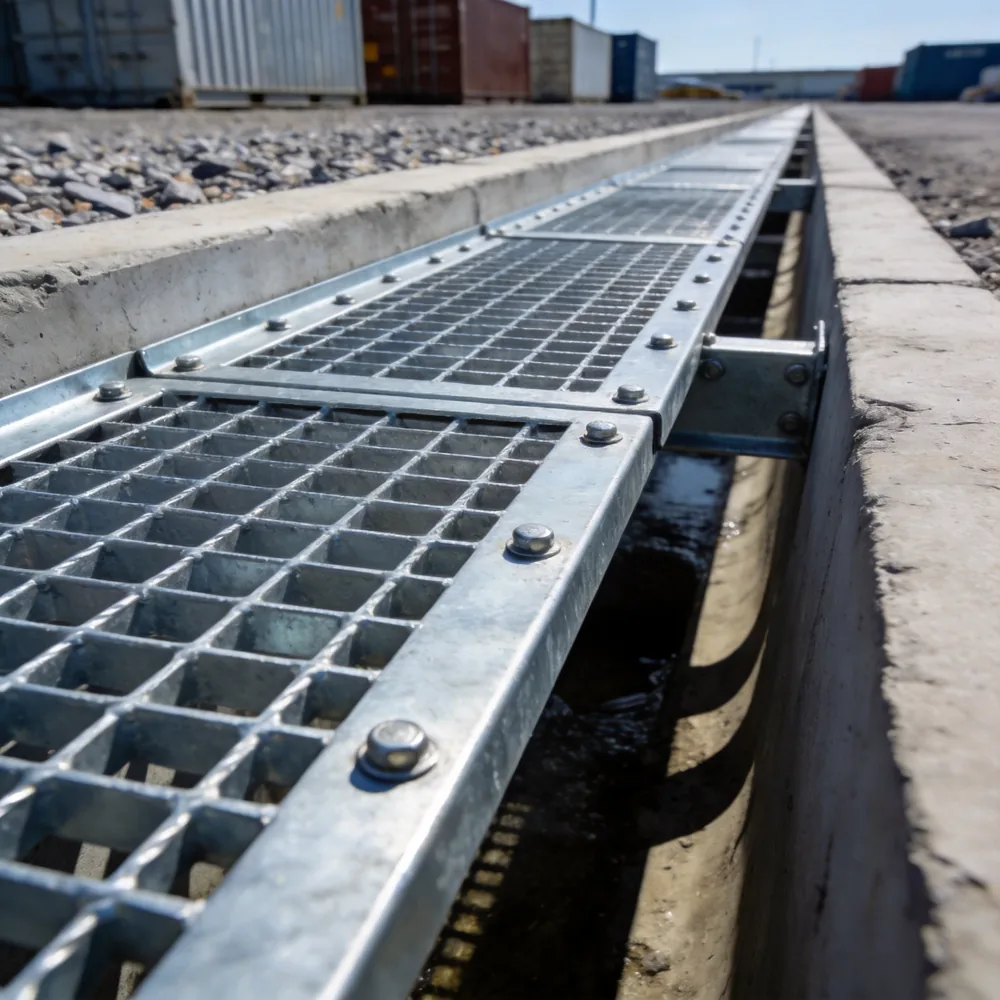
Trench Covers & Channel Gratings — Heavy Duty Access Solutions
GoGrating accepts enquiries for this product family. The written quotation must identify the legal supplier, manufacturing party and location, available construction and materials, fabrication scope, inspection documents, packing and delivery terms. Website examples are not order commitments.
Named standards are purchaser specification inputs, not a claim that every configuration is certified. State the required standard and edition, acceptance criteria, inspection points and documents; the quotation must confirm the applicable scope.
What Are Trench Covers?
A trench cover is a removable grating panel that spans a linear opening in a floor or pavement — typically a drainage channel, cable run, pipe trench, or utility duct. Unlike solid plate, an open-bar grating cover lets surface water pass straight through into the channel while providing a slip-resistant walking or driving surface above. Panels are usually seated in an embedded angle frame cast into the concrete, so covers sit flush with the finished surface and can be lifted individually for cleaning and maintenance.
You will find trench gratings in wastewater treatment plants, highways and car parks, food and beverage facilities, substations, refineries, ports, and airports — anywhere services run below grade. Selecting the right cover comes down to three questions: what loads cross it, what environment surrounds it, and how often it must be lifted. See our applications overview for sector-specific guidance.
Types of Trench Covers
Stainless steel trench covers in grade 304 or 316 suit food processing, pharmaceutical, marine, and chemical environments where hygiene or corrosion resistance rules out galvanized carbon steel. FRP trench covers — molded or pultruded, in orthophthalic, isophthalic, or vinyl ester resins — offer full corrosion resistance within a verified service envelope, electrical non-conductivity, and light weight that lets one worker lift a panel by hand. Covered (gritted solid-top) FRP panels are available where small-object fallthrough must be prevented.
Trench Cover Specifications
Provide clear span, support arrangement, load cases, wheel or point-load footprint, deflection limit and service conditions. Request configuration-specific data or calculations and have safety-critical selections approved by the responsible qualified person.
| Bearing bar size | 20×3 mm to 100×9 mm (flat or serrated) |
| Bearing bar pitch | 19-space and 15-space series (≈30 mm / ≈40 mm centers) |
| Cross bar pitch | 50 mm or 100 mm typical; others to order |
| Load classes | Designed to EN 124 A15 through F900 (engineered per span) |
| Panel dimensions | Cut to trench schedule — no fixed stock sizes |
| Steel materials | Carbon steel Q235/Q345; stainless 304 / 316 |
| FRP options | Molded, pultruded, covered; ortho, iso, vinyl ester resins |
| Surface treatment | Hot-dip galvanized (ASTM A123), untreated, painted |
| Accessories | Embedded angle frames, hinges, lifting holes, locking clips |
| Standards | Reference, edition, conformity scope and documents to be confirmed in the quotation |
- Made to order — no stock SKUs, panels cut to your channel dimensions
- Steel, hot-dip galvanized, stainless 304/316, or FRP construction
- Required standards, editions, inspections and documents confirmed per quotation
- Angle-frame edging, hinges, and locking devices available
- Required standards, editions, inspections and documents confirmed per quotation
- Required standards, editions, inspections and documents confirmed per quotation
Frequently Asked Questions
Can you fabricate trench covers to our project drawings?
GoGrating accepts enquiries for this product family. The written quotation must identify the legal supplier, manufacturing party and location, available construction and materials, fabrication scope, inspection documents, packing and delivery terms. Website examples are not order commitments. Submit drawings with the enquiry so scope can be reviewed before quotation.
What load class should I specify for my trench covers?
Provide clear span, support arrangement, load cases, wheel or point-load footprint, deflection limit and service conditions. Request configuration-specific data or calculations and have safety-critical selections approved by the responsible qualified person.
What is the MOQ and typical lead time for export orders?
Minimum order, production timing, packing, trade terms and destination logistics are confirmed only after the quantity, configuration, process scope and delivery requirements have been reviewed.
Should I choose steel or FRP trench covers?
Choose hot-dip galvanized steel for vehicular loads, heavy industry, and the purchase and whole-life cost to be compared for the verified configuration. Choose stainless 304/316 for hygiene-critical or corrosive food, pharmaceutical, and marine settings. Choose FRP where chemical exposure, electrical conductivity, or manual lifting weight are the deciding factors — FRP panels are often lower in panel mass than steel alternatives; compare the exact product data.
Ready to spec your grating?
Project specifications, documentation needs and export packing are confirmed with each quotation.
Get Engineering Support →