Press Locked Grating — Lightweight, Aesthetic & Precision
Product overview, selection inputs and evidence to confirm in a written quotation.
Sizes and options below are enquiry examples. Ask the quotation to confirm product designation, material, dimensions, load and deflection evidence, finish or resin, standards and editions, inspection documents, manufacturing party, packing and schedule.
Open the RFQ checklist →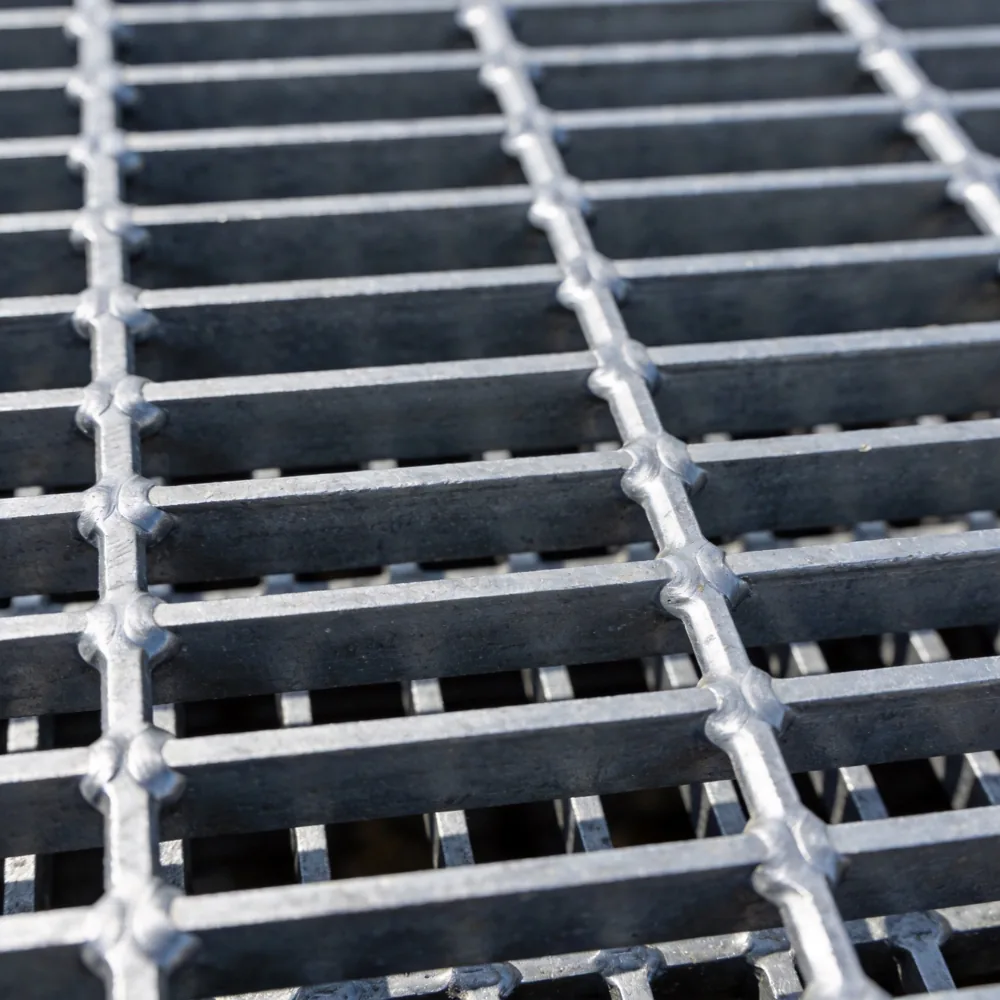
Press Locked Grating — Precision Interlocking Construction
Press locked grating (also called interlocking or mechanical lock grating) is the architect's choice within the steel grating family. Instead of resistance-welding cross bars onto bearing bars, the cross bars are hydraulically pressed into precision-punched slots, locking the two together mechanically. Because nothing is welded, the finished panel has no weld beads, spatter, or heat discoloration — just a clean, uniform grid.
Named standards are purchaser specification inputs, not a claim that every configuration is certified. State the required standard and edition, acceptance criteria, inspection points and documents; the quotation must confirm the applicable scope.
What is Press Locked Grating?
In press locked construction, the bearing bars — the load-carrying flats — are punched with slots at fixed intervals. Cross bars of matching section are then forced into those slots under high hydraulic pressure, deforming the metal at each intersection into a tight mechanical joint. The interlock is permanent and dimensionally precise: every opening in the panel is identical, and both faces of the grating sit flush.
This is what separates press locked grating from welded grating. Welded panels are the workhorse for heavy industrial loads, but each weld point leaves a visible bead. Press locked panels trade some heavy-load capacity for a cleaner appearance and consistent geometry, which is exactly what architectural and light-structural projects call for. For corrosive or non-conductive environments where steel is not ideal, see our FRP grating line as an alternative.
Specifications & Dimensions
Minimum order, production timing, packing, trade terms and destination logistics are confirmed only after the quantity, configuration, process scope and delivery requirements have been reviewed.
Common configurations pair 25×3 to 65×5 mm bearing bars with the 19-space (approx. 30 mm) or 15-space (approx. 25 mm) pitch series, but slot patterns can be punched to suit denser or more open grids. Panels are supplied banded, with cutouts, notches, and kick plates fabricated per drawing.
Ideal Applications for Press Locked Grating
Press locked grating is specified wherever the grating will be seen as well as walked on. Typical uses include building facades and sunshade screens, decorative mezzanines and viewing platforms, interior and exterior walkways with light to medium foot traffic, stair treads in commercial buildings, suspended ceilings, ventilation grilles, tree grates, and infill panels for fencing, balustrades, and safety railing.
Architects and EPC contractors choose it for airports, stadiums, retail developments, office buildings, and public infrastructure where exposed grating contributes to the design language. For heavy vehicular or plant-floor loading, a welded panel is usually the better fit — our team will recommend the right type for each area of your project. Browse more project types on our applications page.
Why Choose Press Locked Grating?
| Construction | Cross bars hydraulically pressed into slotted bearing bars (no welding) |
| Bearing bar size | 20×3 mm to 100×9 mm (depth × thickness), flat bar |
| Bearing bar pitch | 19-space and 15-space series; custom pitches on request |
| Cross bar pitch | Typically 50 mm or 100 mm; custom per drawing |
| Panel size | Made to order; cut, banded, and notched per project drawings |
| Material | Carbon steel (Q235/equivalent), stainless steel 304/316 |
| Surface finish | Hot-dip galvanized (ASTM A123), painted, untreated, or stainless natural |
| Standards | Reference, edition, conformity scope and documents to be confirmed in the quotation |
| Load capacity | Depends on bar size, span, and pitch — engineered load tables on request |
| Accessories | Banding bars, kick plates, stair tread nosings, fixing clips |
- Weld-free pressed joints — no spatter, burn marks, or weld beads
- Flush, uniform top surface suited to visible architectural work
- Bearing bars from 20×3 to 100×9 mm, made to project spec
- Required standards, editions, inspections and documents confirmed per quotation
- Required standards, editions, inspections and documents confirmed per quotation
- Every panel cut, banded, and notched to your drawings — no stock SKUs
Frequently Asked Questions
Can you manufacture press locked grating from our drawings or CAD files?
GoGrating accepts enquiries for this product family. The written quotation must identify the legal supplier, manufacturing party and location, available construction and materials, fabrication scope, inspection documents, packing and delivery terms. Website examples are not order commitments. Submit drawings with the enquiry so scope can be reviewed before quotation.
Is there a minimum order quantity for press locked grating?
Minimum order, production timing, packing, trade terms and destination logistics are confirmed only after the quantity, configuration, process scope and delivery requirements have been reviewed.
What load can press locked grating carry?
Provide clear span, support arrangement, load cases, wheel or point-load footprint, deflection limit and service conditions. Request configuration-specific data or calculations and have safety-critical selections approved by the responsible qualified person.
What is the typical production lead time?
Minimum order, production timing, packing, trade terms and destination logistics are confirmed only after the quantity, configuration, process scope and delivery requirements have been reviewed.
Ready to spec your grating?
Project specifications, documentation needs and export packing are confirmed with each quotation.
Get Engineering Support →