Pultruded FRP Grating — High Strength Directional Design
Product overview, selection inputs and evidence to confirm in a written quotation.
Sizes and options below are enquiry examples. Ask the quotation to confirm product designation, material, dimensions, load and deflection evidence, finish or resin, standards and editions, inspection documents, manufacturing party, packing and schedule.
Open the RFQ checklist →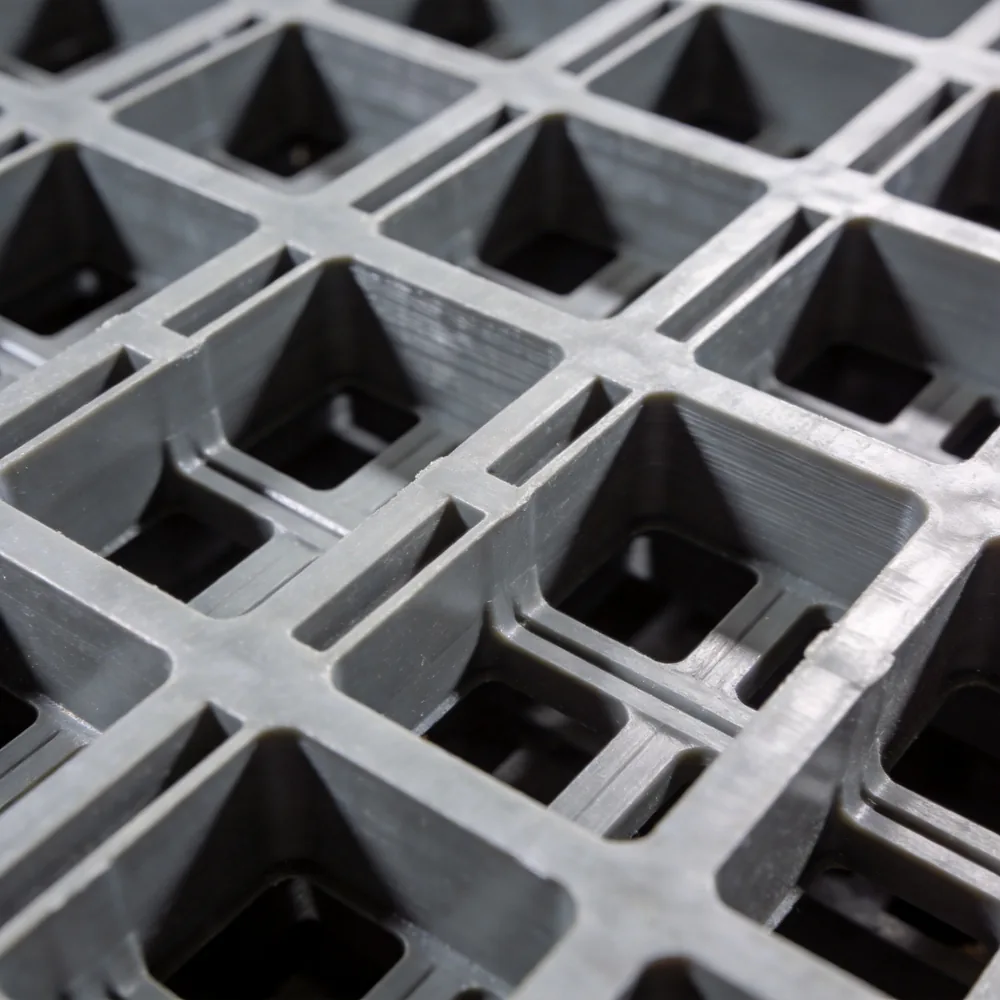
Pultruded FRP Grating — Engineered for High Loads
Minimum order, production timing, packing, trade terms and destination logistics are confirmed only after the quantity, configuration, process scope and delivery requirements have been reviewed.
Because the glass reinforcement in pultruded grating runs continuously along the length of each load bar, the panel behaves much like a series of small structural beams. That directional design gives pultruded grating the highest strength-to-weight ratio in the FRP family, which is why EPC contractors and procurement engineers specify it for heavy-duty platforms, long-span walkways, and trench covers in corrosive plants where steel would require constant maintenance.
What is Pultruded FRP Grating?
Pultrusion is a continuous manufacturing process: bundles of glass rovings and surface mats are pulled through a resin bath, then drawn through a heated steel die that cures the composite into a constant-profile load bar — typically an I-bar or T-bar shape. These bars are then assembled into grating panels with cross rods locking them at fixed spacing. The result is a load bar with roughly 60–70% glass content by weight, far higher than molded grating can achieve.
The key difference from molded FRP grating is directionality. Molded grating is woven in two directions and offers bidirectional strength, which suits general walkways with closely spaced supports. Pultruded grating concentrates its reinforcement in one direction, so it carries significantly higher loads across longer unsupported spans — but it must be installed with the load bars running across the supports, just like steel bar grating.
GoGrating accepts enquiries for this product family. The written quotation must identify the legal supplier, manufacturing party and location, available construction and materials, fabrication scope, inspection documents, packing and delivery terms. Website examples are not order commitments.
Pultruded FRP Specifications
Pultruded grating is a custom-ordered product, so specifications are driven by your project documents rather than a fixed catalog. Typical load bar depths run from 25 mm to 63 mm (1" to 2-1/2"), with bar spacing configured to give roughly 30–60% open area depending on the balance you need between drainage, light passage, and surface coverage. Walking surfaces can be supplied gritted for slip resistance, smooth, or as covered plate grating where spill containment or rolling loads are involved.
Named standards are purchaser specification inputs, not a claim that every configuration is certified. State the required standard and edition, acceptance criteria, inspection points and documents; the quotation must confirm the applicable scope.
Pultruded FRP Applications
Pultruded grating earns its place wherever loads are heavy, supports are far apart, or the environment attacks steel. Common uses include heavy-load industrial platforms and mezzanines in chemical and fertilizer plants, long-span walkways and crossovers in water and wastewater treatment works, stair treads with integrated gritted nosings, cooling tower decks, and dock or marina decking exposed to constant salt spray. Its non-conductive, non-sparking nature also makes it a standard choice around electrical substations and oil and gas facilities.
Many of our buyers in the Middle East, Southeast Asia, Europe, and the United States combine pultruded FRP with hot-dip galvanized steel grating on the same project — steel where cost-per-load governs, FRP where corrosion, weight, or electrical safety governs. Browse our applications guide to see how other EPC contractors and distributors have specified each material, or contact us with your bill of quantities for a combined offer covering both grating lines.
| Manufacturing process | Pultrusion — continuous rovings, resin bath, heated die |
| Load bar profiles | I-bar, T-bar, rectangular tube |
| Bar depth range | 25–63 mm (1" to 2-1/2"), to project spec |
| Open area | Approx. 30–60% depending on bar spacing |
| Glass content (load bars) | Approx. 60–70% by weight |
| Resin systems | Orthophthalic, isophthalic, vinyl ester |
| Walking surface | Gritted, smooth, or covered plate |
| Panel dimensions | Made to order; cut-to-size fabrication available |
| Colors | Yellow, gray, green, dark gray; custom on request |
| Quality system | Reference, edition, conformity scope and documents to be confirmed in the quotation |
- Continuous glass rovings for maximum strength along the span
- Longer unsupported spans than molded FRP grating
- Resin options: orthophthalic, isophthalic, vinyl ester
- Non-conductive, non-sparking, corrosion resistant
- Gritted, smooth, or covered walking surfaces
- Required standards, editions, inspections and documents confirmed per quotation
Frequently Asked Questions
Can pultruded FRP grating be fabricated to my project drawings?
GoGrating accepts enquiries for this product family. The written quotation must identify the legal supplier, manufacturing party and location, available construction and materials, fabrication scope, inspection documents, packing and delivery terms. Website examples are not order commitments. Submit drawings with the enquiry so scope can be reviewed before quotation.
Is there a minimum order quantity for pultruded FRP grating?
Minimum order, production timing, packing, trade terms and destination logistics are confirmed only after the quantity, configuration, process scope and delivery requirements have been reviewed.
How long is the production lead time for an export order?
Minimum order, production timing, packing, trade terms and destination logistics are confirmed only after the quantity, configuration, process scope and delivery requirements have been reviewed.
What standards and load data do you provide?
Named standards are purchaser specification inputs, not a claim that every configuration is certified. State the required standard and edition, acceptance criteria, inspection points and documents; the quotation must confirm the applicable scope.
Ready to spec your grating?
Project specifications, documentation needs and export packing are confirmed with each quotation.
Get Engineering Support →