Molded FRP Grating — One-Piece Construction
Product overview, selection inputs and evidence to confirm in a written quotation.
Sizes and options below are enquiry examples. Ask the quotation to confirm product designation, material, dimensions, load and deflection evidence, finish or resin, standards and editions, inspection documents, manufacturing party, packing and schedule.
Open the RFQ checklist →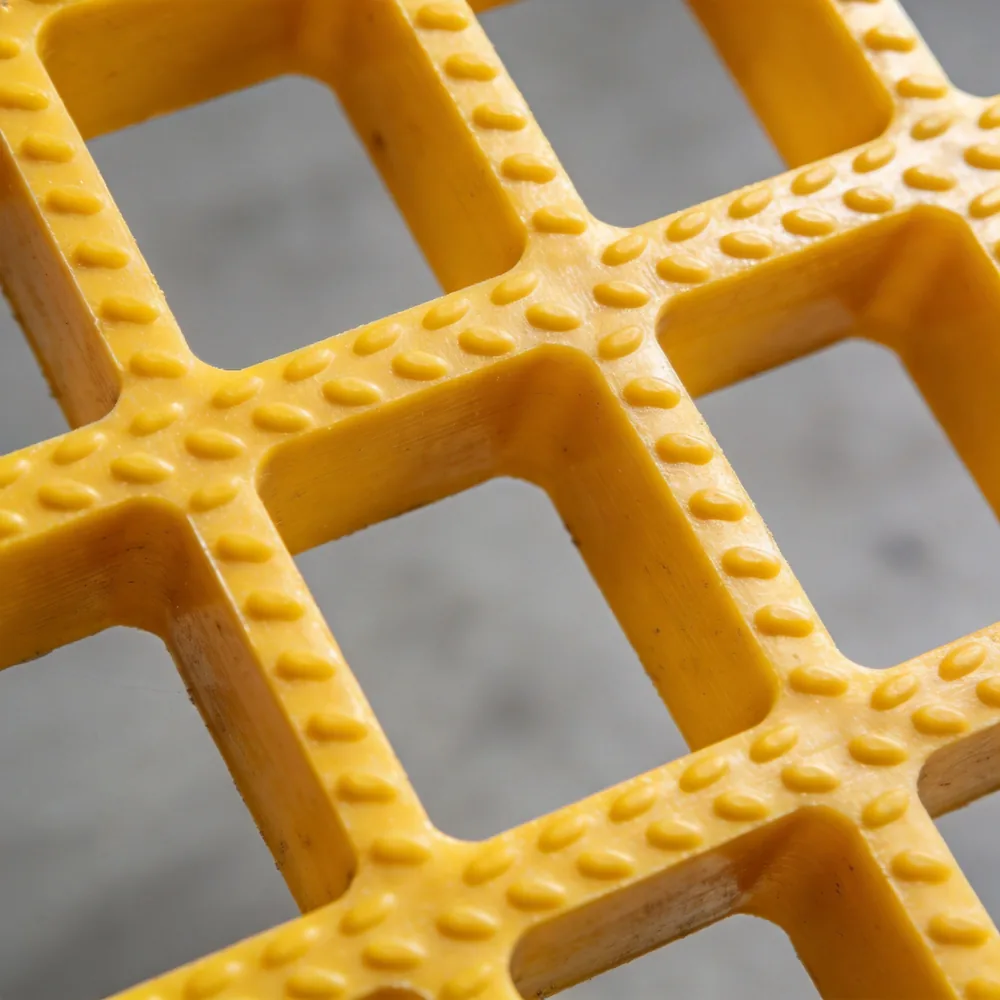
Molded FRP Grating — Seamless Composite Construction
GoGrating accepts enquiries for this product family. The written quotation must identify the legal supplier, manufacturing party and location, available construction and materials, fabrication scope, inspection documents, packing and delivery terms. Website examples are not order commitments.
Minimum order, production timing, packing, trade terms and destination logistics are confirmed only after the quantity, configuration, process scope and delivery requirements have been reviewed.
What is Molded FRP Grating?
Molded FRP grating is produced in a heated, open mold. Continuous glass-fiber rovings are laid in alternating layers — lengthwise and crosswise — and each layer is fully wetted out with thermoset resin before the next is placed. When the filled mold is cured, the entire panel solidifies as one piece: the bearing bars and cross-bars are not assembled or bonded together, they are literally the same continuous material.
This one-piece construction is what separates molded grating from welded steel grating and from pultruded FRP. Because the glass reinforcement runs in both directions, a molded panel carries load bidirectionally and tolerates cut-outs, penetrations, and field cutting without unraveling or losing its structure. Cut edges are simply sealed with resin to restore full corrosion protection.
Provide clear span, support arrangement, load cases, wheel or point-load footprint, deflection limit and service conditions. Request configuration-specific data or calculations and have safety-critical selections approved by the responsible qualified person.
Molded FRP Specifications
Standard molded meshes include 38×38 mm, 25×25 mm, 19×19 mm, and 50×50 mm squares, with rectangular and micro-mesh patterns available to order. Panel thicknesses run from 12.7 mm to 63.5 mm (1/2" to 2-1/2"), and common mold sizes such as 1220×3660 mm and 1220×2440 mm are cut to your exact platform dimensions. Surfaces can be supplied with a concave (meniscus) top, a gritted anti-slip layer, a smooth finish, or a bonded cover plate.
Named standards are purchaser specification inputs, not a claim that every configuration is certified. State the required standard and edition, acceptance criteria, inspection points and documents; the quotation must confirm the applicable scope.
Molded FRP Applications
Chemical and petrochemical plants are the classic home of molded grating: walkways, platforms, and trench covers around acid storage, electroplating lines, and chlor-alkali processes where galvanized steel corrodes in months. Water and wastewater treatment plants use it over clarifiers, aeration basins, and screening areas for the same reason, with the added benefit that a one-piece panel has no welds to fail in permanently humid, H2S-laden air.
Marine and offshore facilities specify molded grating for docks, seawater intake structures, and splash-zone platforms; food and beverage plants choose it for wash-down areas because it is impervious to cleaning chemicals and available in USDA-acceptable smooth-top formats. Its non-conductive, non-sparking nature also suits electrical substations and hazardous zones. See more end-use detail on our applications pages.
| Construction | One-piece molded; continuous interwoven glass rovings, no joints |
| Mesh sizes | 19×19, 25×25, 38×38, 50×50 mm squares; rectangular meshes to order |
| Panel thickness | 12.7 – 63.5 mm (1/2" – 2-1/2") |
| Standard mold sizes | Reference, edition, conformity scope and documents to be confirmed in the quotation |
| Resin systems | Orthophthalic, isophthalic, vinyl ester |
| Surface options | Concave (meniscus), gritted anti-slip, smooth, covered plate |
| Colors | Yellow, green, grey, light grey; custom colors on request |
| Open area | Up to approx. 70%, depending on mesh pattern |
| Fire performance | Specify the required test method and classification; require a current report matched to the quoted product |
| Quality & compliance | Reference, edition, conformity scope and documents to be confirmed in the quotation |
- Seamless one-piece construction — no welds, rivets, or mechanical joints to corrode or loosen
- Bidirectional load distribution from continuous interwoven glass rovings
- Resin systems matched to service: orthophthalic, isophthalic, or vinyl ester
- Non-conductive and non-sparking — suitable for electrical and hazardous areas
- Often lower in panel mass than steel alternatives; compare the exact product data for easier handling
- Concave or gritted anti-slip walking surfaces as standard options
Frequently Asked Questions
Can molded FRP grating be cut and fabricated to my drawings?
GoGrating accepts enquiries for this product family. The written quotation must identify the legal supplier, manufacturing party and location, available construction and materials, fabrication scope, inspection documents, packing and delivery terms. Website examples are not order commitments. Submit drawings with the enquiry so scope can be reviewed before quotation.
Is there a minimum order quantity and what is the typical lead time?
Minimum order, production timing, packing, trade terms and destination logistics are confirmed only after the quantity, configuration, process scope and delivery requirements have been reviewed.
Which resin should I specify — orthophthalic, isophthalic, or vinyl ester?
Provide clear span, support arrangement, load cases, wheel or point-load footprint, deflection limit and service conditions. Request configuration-specific data or calculations and have safety-critical selections approved by the responsible qualified person.
How does molded FRP grating compare with pultruded FRP and steel grating?
Provide clear span, support arrangement, load cases, wheel or point-load footprint, deflection limit and service conditions. Request configuration-specific data or calculations and have safety-critical selections approved by the responsible qualified person.
Ready to spec your grating?
Project specifications, documentation needs and export packing are confirmed with each quotation.
Get Engineering Support →