HomeApplications › Grating for Wastewater Treatment

Grating for Wastewater Treatment — Corrosion Resistant Solutions

Corrosion-resistant FRP and hot-dip galvanized steel grating for clarifiers, aeration basins, sludge areas and chemical dosing rooms — fabricated to your project drawings in Anping, China.

Quick AnswerWastewater treatment plant grating covers walkways, platforms, trench drains, and equipment access areas in WWTPs. Because sewage environments combine moisture, hydrogen sulfide, and treatment chemicals, the usual choices are molded or pultruded FRP grating for chemical zones and hot-dip galvanized steel grating (ASTM A123) for structural spans — both fabricated to project dimensions rather than stock sizes.
Grating for Wastewater Treatment

Grating for Wastewater Treatment Plants

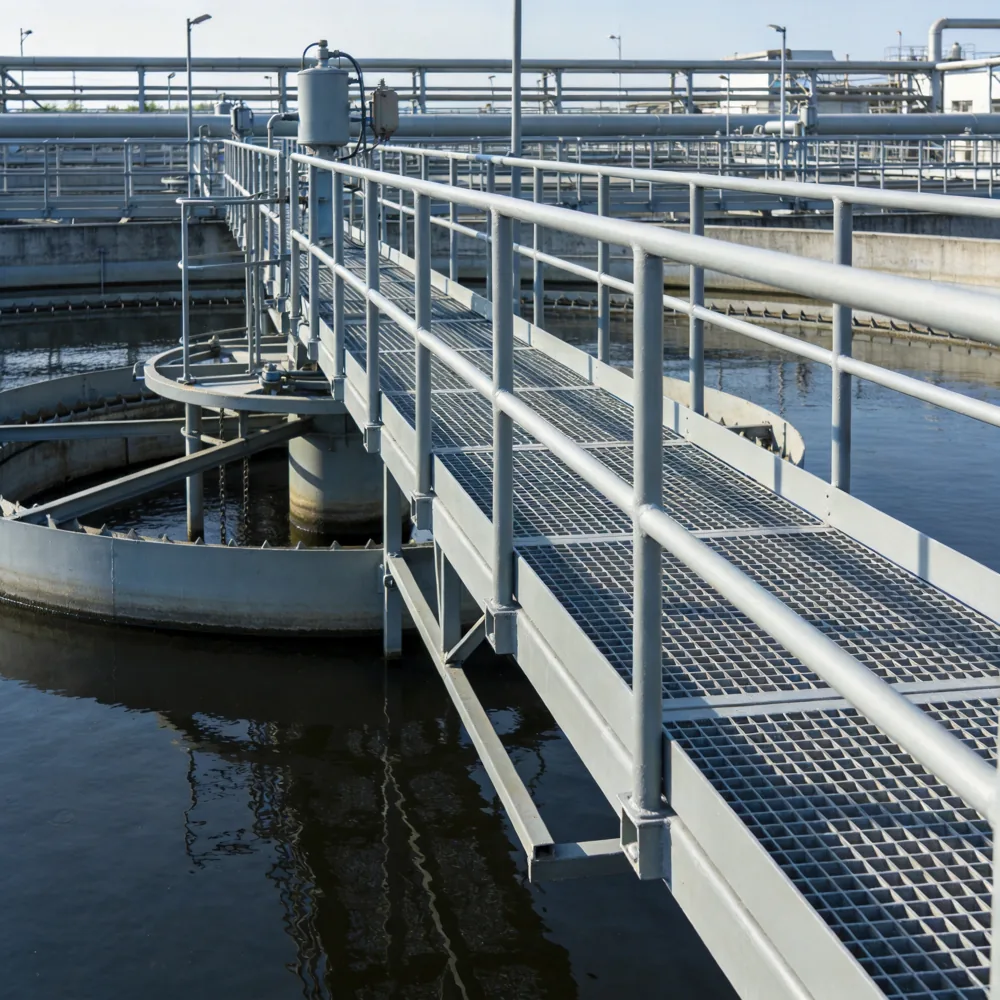
Wastewater treatment plants are among the most demanding environments a grating panel can serve in. Walkways over aeration basins, access platforms around clarifiers, covers on effluent trenches, screening-room floors and stair treads in sludge-handling buildings all sit in permanent contact with moisture, sewage gases and treatment chemicals. Grating in a WWTP is not a commodity floor product — it is a safety-critical component that has to keep operators on their feet for decades while everything around it tries to corrode.

GoGrating supplies steel grating and FRP grating for wastewater treatment projects factory-direct from Anping, Hebei — China's grating and wire-mesh manufacturing hub. Every order is fabricated to the project's panel schedule, not pulled from stock SKUs, which is why EPC contractors and procurement engineers typically send us drawings or a bill of quantities rather than a catalog number. See our full applications overview for other industries we serve.

Why Grating Matters in WWTP

Sewage treatment exposes metal to a uniquely aggressive cocktail: hydrogen sulfide and other sewer gases, chlorides, ferric chloride and polymer dosing chemicals, chlorine or hypochlorite in disinfection stages, and near-constant humidity with wet/dry cycling. Untreated mild steel grating in these conditions can lose its section alarmingly fast, and a corroded walkway over an open basin is a direct fall hazard for plant operators.

Replacement is also expensive in ways the purchase order never shows — basins may need to be taken offline, confined-space permits arranged, and lifting access restored. Specifying the right material and surface treatment at the procurement stage is therefore far cheaper than re-decking a plant mid-life. That decision usually comes down to two proven options: FRP grating for the most chemically aggressive zones, and hot-dip galvanized steel grating where structural stiffness governs.

Recommended Products

FRP grating is the default choice for immersion zones, splash zones and rooms with H2S or chemical vapor: it cannot rust, is non-conductive, and weighs a fraction of steel, which simplifies installation over live basins. Molded FRP grating suits walkways and trench covers; pultruded FRP handles longer spans and heavier duty; covered (solid-top) panels are used where drop-through must be prevented. Resin selection is matched to the exposure — orthophthalic for general duty, isophthalic for moderate chemical service, and vinyl ester for the harshest dosing and disinfection areas.

Hot-dip galvanized steel grating remains the workhorse for structural platforms, stair treads and vehicle-rated trench covers. We fabricate welded steel grating with bearing bars from 20x3 mm up to 100x9 mm in 19-space and 15-space series, hot-dip galvanized to ASTM A123 for long service life in damp, above-water areas. For chemical dosing rooms and other concentrated-exposure locations, stainless steel 304 or 316 grating is available as an upgrade.

Most plants end up with a mixed package — FRP in the wet wells and chemical buildings, galvanized steel on the main pipe galleries and platforms. Send us your area list and we will recommend a material split zone by zone.

WWTP Technical Requirements

Chemical resistance is the first specification gate. For FRP, that means stating the chemicals and concentrations present so the correct resin system can be selected; for steel, it means choosing between hot-dip galvanizing, painted finishes or stainless 304/316 based on the exposure category. We do not publish one-size-fits-all corrosion claims — tell us the environment and we will match it against resin and coating suitability data.

Anti-slip performance is the second. Wet concrete-and-grating walkways are a known slip risk, so WWTP specifications commonly call for serrated bearing bars on steel grating and a concave or grit-top surface on FRP grating. Both are standard options on our production lines.

Load capacity and span are engineered per project against YB/T 4001.1 and ANSI/NAAMM MBG 531; we deliberately avoid quoting generic load numbers here because the right answer depends on bar size, pitch and clear span. Our factory operates under ISO 9001 with CE-marked product lines. Send your drawings, CAD files or area schedule via our Request a Quote page and our engineers will return a panel layout with the applicable load tables.

  • Molded and pultruded FRP grating in orthophthalic, isophthalic and vinyl ester resins
  • Hot-dip galvanized steel grating per ASTM A123 for structural walkways and platforms
  • Bearing bar range 20x3 to 100x9 mm, 19-space and 15-space series
  • Serrated bars and gritted FRP surfaces for anti-slip duty
  • Stainless 304/316 options for dosing and disinfection rooms
  • Panels cut to project drawings — cut-outs, banding and nonstandard sizes welcome

Frequently Asked Questions

Can you manufacture grating to our WWTP project drawings?

Yes — custom fabrication is our standard business model, not an exception. Send DWG, PDF or STEP drawings, or simply an area schedule with dimensions, and we will produce a panel layout with cut-outs, banding, kick plates and fixings to suit. Nonstandard panel sizes are made to order.

Should we choose FRP or galvanized steel grating for our treatment plant?

It depends on the zone. FRP grating (typically vinyl ester resin) is recommended for immersion, splash and chemical dosing areas where steel corrodes fastest; hot-dip galvanized steel grating per ASTM A123 suits structural platforms and longer spans in above-water areas. Most plants combine both, and we can recommend a split per area.

Which standards do your gratings comply with?

Steel grating is manufactured to YB/T 4001.1 and ANSI/NAAMM MBG 531, with hot-dip galvanizing to ASTM A123. Our factory is ISO 9001 certified and offers CE-marked product lines. Engineered load tables for your specific bar size, pitch and span are provided with the quotation.

What are the MOQ and lead time for a wastewater project order?

There is no rigid MOQ for project lots — we quote based on your panel schedule, from trial areas to full-plant packages. Lead time depends on quantity, material and surface treatment, and is confirmed with the quotation. Request a quote with your drawings for a firm production schedule.

Ready to spec your grating?

Factory-direct from Anping — engineered, certified, and shipped worldwide.

Get Engineering Support →