HomeApplications › Grating for Oil & Gas

Grating for Oil & Gas — Offshore, Refinery & Petrochemical

Factory-direct steel and FRP grating for offshore platforms, refineries, and petrochemical plants — fabricated to your project drawings in Anping, China, and shipped worldwide.

Quick AnswerOil and gas grating is open-grid flooring used on offshore platforms, refineries, and petrochemical plants for walkways, stair treads, and equipment platforms. Typical options are hot-dip galvanized steel grating (ASTM A123), stainless 304/316 grating, and FRP grating in vinyl ester resin — selected for corrosion resistance, slip resistance, and load rating per ANSI/NAAMM MBG 531 or YB/T 4001.1.
Grating for Oil & Gas

Grating for Oil & Gas Industry — Offshore & Onshore Solutions

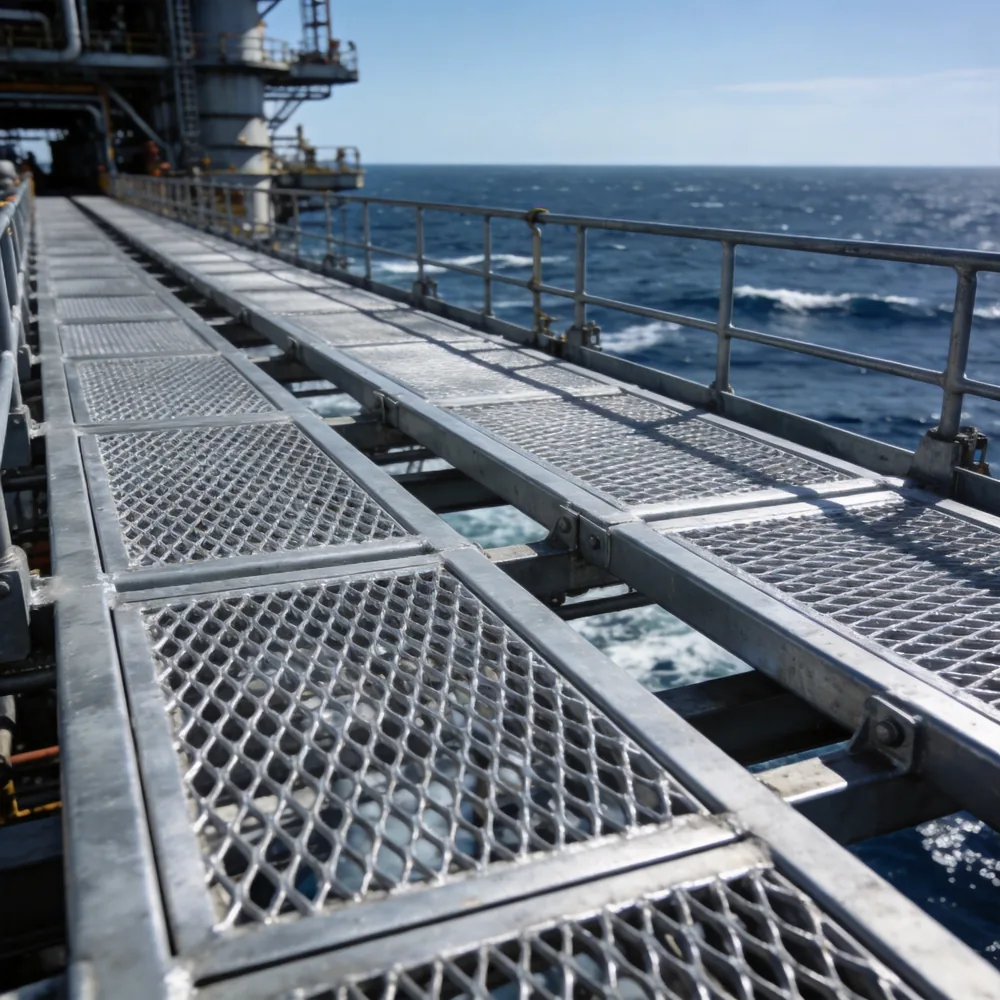
Few industries demand more from walkway grating than oil and gas. Offshore platforms, FPSO modules, refineries, petrochemical complexes, tank farms, and onshore wellsites all rely on open-grid flooring for walkways, stair treads, equipment platforms, drain covers, and cable-tray protection — often in environments that destroy ordinary mild steel within a few seasons.

GoGrating supplies steel grating and FRP grating for oil and gas projects factory-direct from Anping, Hebei — China's grating and wire-mesh manufacturing hub. Every order is fabricated to project specification rather than pulled from stock: EPC contractors and procurement engineers send us layout drawings or a bill of materials, and we return panel schedules, fabrication drawings, and a firm quotation. Browse steel grating, FRP grating, or other applications to compare options.

Grating Requirements in Oil & Gas

Oil and gas facilities combine two pressures that drive grating selection: aggressive corrosion and strict safety compliance. Offshore decks face continuous salt spray and humidity; refinery and petrochemical process areas add hydrocarbon residue, chemical splash, sour-gas atmospheres, and washdown chemicals. An unprotected carbon steel panel that lasts decades inland can fail quickly in these conditions, so surface treatment and material choice matter as much as the load path.

On the safety side, project specifications typically call up recognized fabrication standards — YB/T 4001.1 in China and ANSI/NAAMM MBG 531 for North American and international EPC work — together with ASTM A123 for hot-dip galvanizing. GoGrating operates an ISO 9001 quality system and can support CE marking, mill certificates, and third-party inspection where the project requires it.

Recommended Grating Products for O&G

Hot-dip galvanized steel grating is the workhorse for most onshore oil and gas structures: pipe racks, platform flooring, stair treads, and trench covers. Galvanizing to ASTM A123 gives a sacrificial zinc layer well suited to outdoor industrial atmospheres, at the most economical cost per square meter. See the full range on our steel grating page.

Stainless steel grating in 304 or 316 suits process areas with chemical splash, frequent washdown, or hygiene requirements where zinc coatings are unsuitable. Grade 316 is the usual choice for marine and chloride-rich exposure; 304 covers milder chemical service. Stainless panels follow the same bearing-bar and pitch series as carbon steel, so they can drop into mixed-material layouts.

FRP grating — molded or pultruded — is increasingly specified for offshore platforms, splash zones, and chemical-handling areas because it cannot rust, weighs a fraction of steel, and is non-conductive. We mold in orthophthalic, isophthalic, and vinyl ester resins; vinyl ester is the standard recommendation for offshore and sour service. Covered (plated) FRP grating is available where dropped-object protection or solid flooring is required. Details on the FRP grating page.

Technical Requirements

Slip resistance. Wet, oily decks are the norm in oil and gas, so most projects specify serrated bearing bars; FRP grating uses a concave or grit-top walking surface. Plain-top grating remains available where serration is not required.

Load capacity. Bearing bars run from roughly 20×3 mm for light pedestrian duty up to 100×9 mm for heavy equipment platforms and large clear spans, in 19-space and 15-space pitch series. We do not publish generic load numbers — span, support conditions, and the governing standard all change the answer. Tell us your span and design load and we will match a section from engineered load tables per MBG 531 or YB/T 4001.1.

Fire and corrosion. Steel grating is non-combustible by nature; FRP grating can be supplied in fire-retardant resin systems where the specification calls for them. For corrosion, the hierarchy is straightforward: hot-dip galvanized for general outdoor service, stainless 316 or vinyl ester FRP for marine and chemical exposure, and untreated or painted finishes only for sheltered or short-term duty.

O&G Project References

Anping's grating cluster — more than 800 fabrication plants within 30 km — has supplied oil and gas projects for decades, and GoGrating's typical scope reflects that: galvanized walkway and stair-tread packages for refinery and tank-farm expansions in the Middle East; cut-to-shape platform grating for petrochemical plants in Southeast Asia; and molded FRP panels in vinyl ester resin for offshore and marine-terminal work in Europe, Australia, and the Americas.

If you are pricing a current package, the fastest route is to send your grating layout, bill of quantities, or even a marked-up GA drawing through our Request a Quote form. CAD files are welcome — our engineers will confirm panel sizes, banding details, and surface treatment, and come back with a complete project quotation.

  • Hot-dip galvanized to ASTM A123 for offshore and coastal service
  • Stainless 304/316 grating for process areas with chemical exposure
  • FRP grating in orthophthalic, isophthalic, and vinyl ester resins
  • Serrated bearing bars for slip resistance on wet, oily decks
  • Cut-to-size fabrication from your layout drawings — CAD welcome
  • ISO 9001 quality system; CE available; engineered load tables on request

Frequently Asked Questions

Can you fabricate grating to our project drawings?

Yes. Oil and gas grating is almost always cut-to-size with banding, openings, and notches per layout drawings. Send DWG, DXF, STEP, or PDF drawings with your inquiry at /contact/request-quote/ and our engineers will return a panel schedule and fabrication drawings for approval before production.

What is the minimum order quantity for oil & gas grating?

There is no fixed MOQ — we are a project-based factory, not a stockist. Small trial orders and sample panels are possible, though sea-freight economics usually favor consolidated shipments. For LCL or mixed-container orders, tell us your destination port and we will advise the most efficient packing.

What standards and certifications do your gratings meet?

Steel grating is fabricated to YB/T 4001.1 or ANSI/NAAMM MBG 531, with hot-dip galvanizing per ASTM A123. Our quality system is ISO 9001 certified and CE marking is available where applicable. Mill certificates, galvanizing reports, and dimensional inspection records can be supplied with each shipment.

What is the typical lead time for an oil & gas grating order?

Lead time depends on tonnage, fabrication complexity, and surface treatment. Standard rectangular panels ship fastest; heavily cut-to-shape packages with stainless or FRP items take longer. After drawing approval we confirm a firm production schedule — share your required delivery date and we will plan around it.

Ready to spec your grating?

Factory-direct from Anping — engineered, certified, and shipped worldwide.

Get Engineering Support →